
Michael Arden had always believed that life rewarded those who stayed ahead of it. If you planned far enough, worked hard enough, and never let yourself slow down long enough to feel fear, then nothing could truly surprise you. That belief had carried him from a childhood of rented apartments and secondhand furniture to a corner office overlooking the harbor in a major East Coast city. His investment firm specialized in healthcare infrastructure, and his name appeared regularly in articles praising innovation, efficiency, and forward thinking leadership.
Yet none of those carefully built certainties mattered on the morning his son did not come home from school.
Twelve year old Noah Arden had always been the quiet kind of child, the sort who noticed things adults forgot to look at. He asked thoughtful questions, listened more than he spoke, and had an annoying habit of chewing on the ends of pens whenever he felt anxious or lost in thought. On a cold, rain soaked morning in early autumn, Noah sat at the kitchen counter, his backpack resting at his feet, staring at his breakfast without touching it.
“Dad,” he said at last, his voice hesitant but steady, “can I ask you something before I go?”
Michael barely looked up from his phone. “Of course. What is it?”
“When we drove past that old community building near the river yesterday, there were kids standing outside,” Noah said. “Some of them looked about my age. Why do they not have anywhere to live?”
The question lingered in the air longer than Michael expected. He knew the building. He had driven past it for years, always aware of it in the abstract, never close enough to feel responsible.
“It is complicated,” he replied after a moment, choosing the safest answer he knew. “We can talk about it another time.”
Noah nodded, though the look in his eyes suggested disappointment more than understanding. Michael did not notice. His phone vibrated again. Another meeting reminder. Another reason to hurry. He kissed Noah’s hair, grabbed his coat, and left.
Three hours later, his assistant’s voice came through the phone, tight with panic. Noah had collapsed in the hallway between classes. By the time Michael reached the hospital, his son lay unconscious, surrounded by machines that beeped and hissed with an efficiency that felt cruel in its calmness.
Doctors spoke in measured tones, explaining procedures, listing test results, offering reassurances that felt hollow even as they were spoken. No signs of trauma. No history of illness. No clear explanation. Noah’s breathing was shallow, supported by a machine that rose and fell where his chest should have.
Days blurred together. Michael stopped going home. He slept in a chair beside Noah’s bed, waking every time a monitor changed rhythm. Specialists arrived from different states, each carrying confidence, each leaving with uncertainty written across their faces. Blood tests returned normal. Imaging showed nothing definitive. Noah continued to weaken, his body growing thinner, quieter, as though retreating from the world.
“I will do anything,” Michael told them one night, his voice raw from exhaustion. “There has to be something you are missing.”
Weeks passed. Hope thinned.

One evening, after a doctor gently suggested that they were running out of options, Michael walked out of the hospital without knowing where he was going. His car carried him through neighborhoods he rarely visited, past boarded storefronts and cracked sidewalks, until he found himself parked in front of a narrow brick building with a flickering porch light and a faded sign that read Harbor Hands Outreach.
Inside, warmth replaced the cold night air. Children sat on worn benches eating soup from chipped bowls. An elderly woman moved among them with practiced ease, touching shoulders, murmuring encouragement, making sure no one was forgotten. Her name was Mrs. Pauline Reed, though everyone simply called her Miss Paulie.
In the corner sat a boy named Owen, ten years old, thin as a reed, his knees drawn up beneath him as he read from an old medical textbook with a torn cover. He looked up when Michael entered, studying him with an intensity that made Michael uncomfortable in a way he could not explain.
Michael spoke with Miss Paulie for nearly an hour. He told her about Noah, about the machines, about the doctors who could not explain why his son was fading away. She listened without interrupting, her expression calm, her hands folded neatly in her lap.
“Sometimes,” she said when he finished, “the answer is not hidden. It is just sitting in a place people do not think to look.”
As Michael turned to leave, the boy from the corner spoke.
“I hope your son gets better,” Owen said quietly. “Small things can cause big problems if no one notices them.”
Michael thanked him, distracted, and drove back to the hospital.
That night, the alarms went off.
Noah’s oxygen levels dropped suddenly, his heart rate becoming erratic. Nurses rushed in. Doctors crowded the room. Michael stood frozen against the wall, watching strangers fight to keep his son alive.
Dr. Rachel Simmons, a specialist in rare respiratory conditions, studied the monitors with a growing frown. “This does not behave like a disease,” she said slowly. “It behaves like something mechanical, like airflow is being disrupted.”
“We have scanned everything,” another doctor said.
“Then we scan again,” Dr. Simmons replied. “Differently.”
Before preparations were complete, Miss Paulie arrived with Owen. Security hesitated, but Michael waved them through without thinking. Something in his chest told him this mattered.
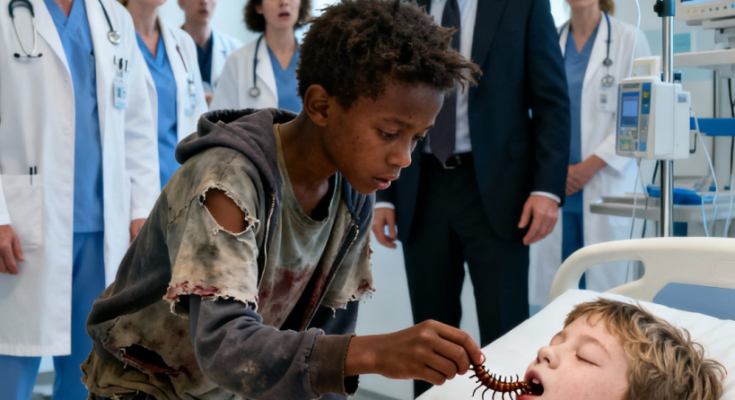
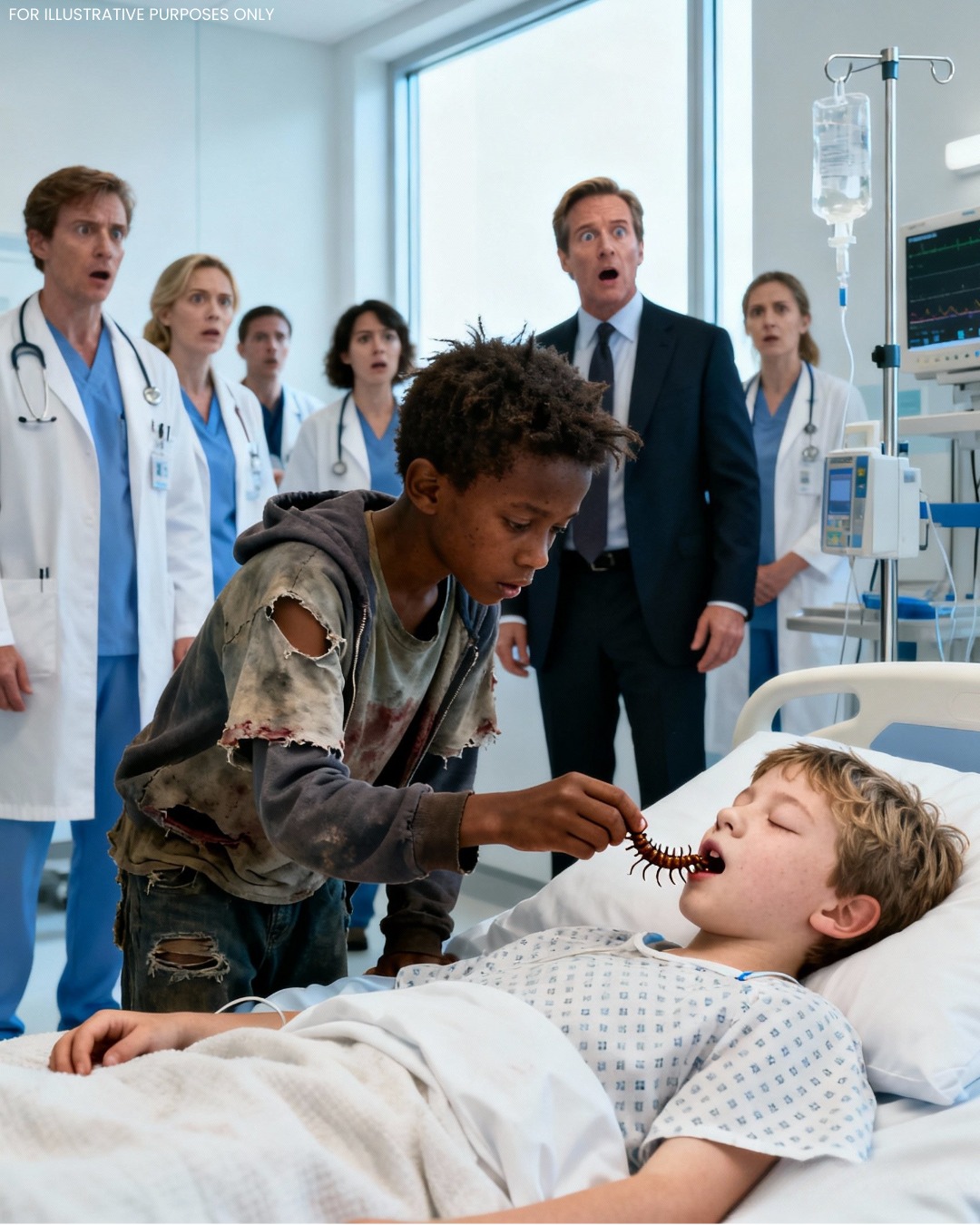
Owen approached Noah’s bed slowly, his eyes fixed not on the screens but on Noah’s throat, on the subtle rise and fall that did not quite look right.
“There,” Owen whispered.
Dr. Simmons leaned closer. “What do you see?”
“It catches,” Owen said. “Every time he breathes in. Like something is stuck.”
Silence filled the room.

An emergency procedure was ordered. The camera moved deeper than before, angling through curves that had been dismissed. Then it appeared, a tiny piece of blue plastic lodged deep within a fold of tissue, shifting with each breath like a hidden valve.
Dr. Simmons removed it with steady hands.
Noah’s oxygen levels stabilized almost immediately.
Hours later, Noah opened his eyes.
“Dad,” he whispered.
Michael broke. In the days that followed, Noah explained what had happened weeks earlier. A shove in the hallway. A pen cap between his teeth. A sudden gasp. A moment he thought was nothing.
Recovery came slowly, but it came. Michael did not forget Owen. Six months later, Harbor Hands reopened as something new. Bright rooms. Real beds. A library. A place where children were not invisible.
One evening, Michael sat with Noah beneath the stars.
“Is it still complicated?” Noah asked softly.
Michael smiled, finally understanding. “No. It never was.”
Inside, Owen laughed with other children, and a man who once believed success was everything learned what it meant to truly see.